How to Fix Banging Water Pipes (Water Hammer) in One Evening
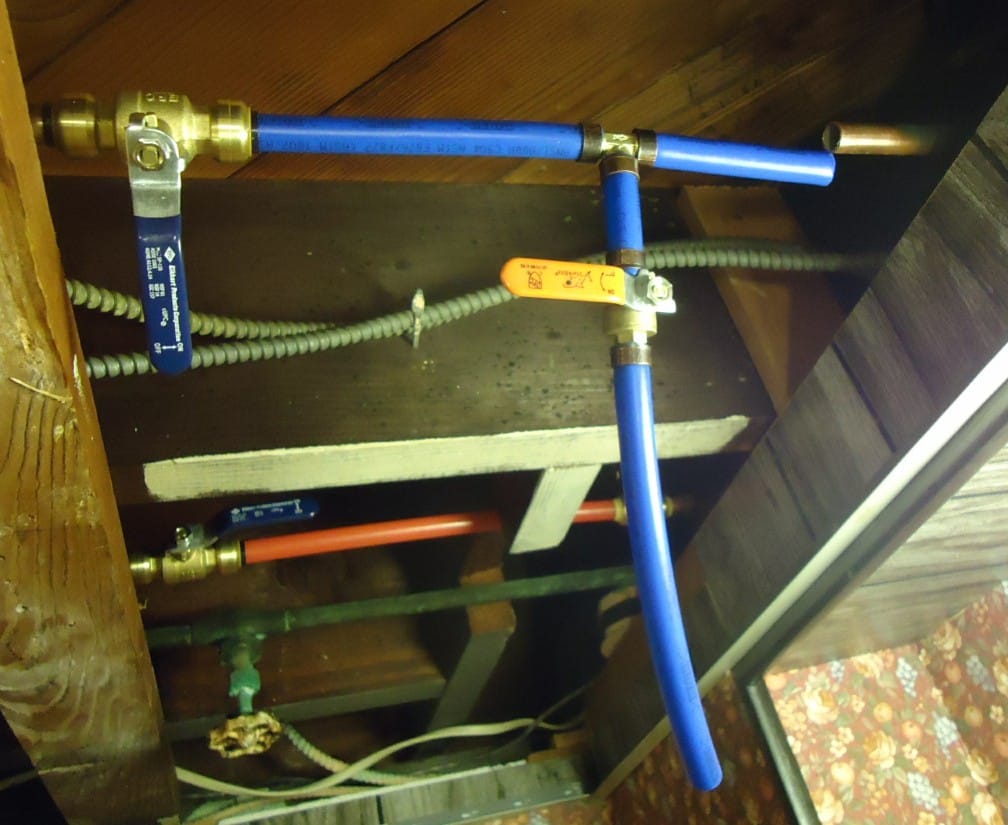
Cover photo by Tomwsulcer via Wikimedia Commons, CC0, resized.
If this fix touches water, gas, or power, the guide starts with the shutoff step and says when a licensed pro should take over.
Product links in this guide are affiliate links. If you buy through one, we may earn a small commission at no extra cost to you. It never changes which products we recommend.
You shut off the tap and the whole house thumps. Or the washing machine finishes filling and the wall shudders with a bang that you can hear upstairs. That’s water hammer, and it’s more of a pressure problem than a pipe problem. Most of the fixes cost less than a pizza, and none of them needs a plumber.
Quick Answer
To fix banging water pipes, work through four steps in order. First, identify which fixture triggers the bang. Second, check the house water pressure with a $10 gauge, and if it reads above 80 psi, the pressure regulator needs attention. Third, strap any loose pipes you can reach to the framing with padded clamps. Fourth, screw a water hammer arrestor, $10 to $20, onto the supply line of the noisy fixture. The whole job is 30 to 90 minutes and $5 to $60. If the banging happens inside a wall you can’t open, or pressure stays high after a new regulator, call a plumber.
What You’ll Need
- A water pressure gauge, $8–$15, that threads onto an outdoor spigot or washing machine valve
- Water hammer arrestors, $10–$20 each, in the size that matches the supply line
- Padded pipe clamps, $5–$10, or foam pipe wrap
- An adjustable wrench and pliers
- A helper, to trigger the noise while you listen
Step-by-Step
Find the fixture that makes the noise
Have someone open and close each tap, flush each toilet, and run the dishwasher and washing machine one at a time while you walk the house and listen. Note where the bang is loudest and what was running. A dishwasher or washer that bangs at the end of each fill is the usual suspect, and a single-lever faucet that slams shut is the next. A toilet that knocks while its tank fills points to a failing fill valve, a different fix entirely.
Check the water pressure
Thread the gauge onto an outdoor spigot or the washing machine’s cold valve, turn the water on, and read it. Home water pressure should sit between 40 and 60 psi. Anything above 80 psi stresses fixtures and makes water hammer worse. If yours is high, the pressure regulator, a bell-shaped valve near where the main enters the house, is worn out or set too high. Replacing one is a plumber job in most cases, $300 to $700, and it also protects the water heater and appliance hoses.
Strap loose pipes
If the bang is a thump from a pipe slamming against a joist, the pipe is loose. Crawl-space and basement pipes are the easiest to reach. Fit padded clamps every 4 to 6 feet on horizontal runs, and at every elbow, screwed into the joist. Foam pipe wrap between the pipe and the wood stops contact noise. A pipe that can move even a quarter inch will knock when the pressure wave hits.
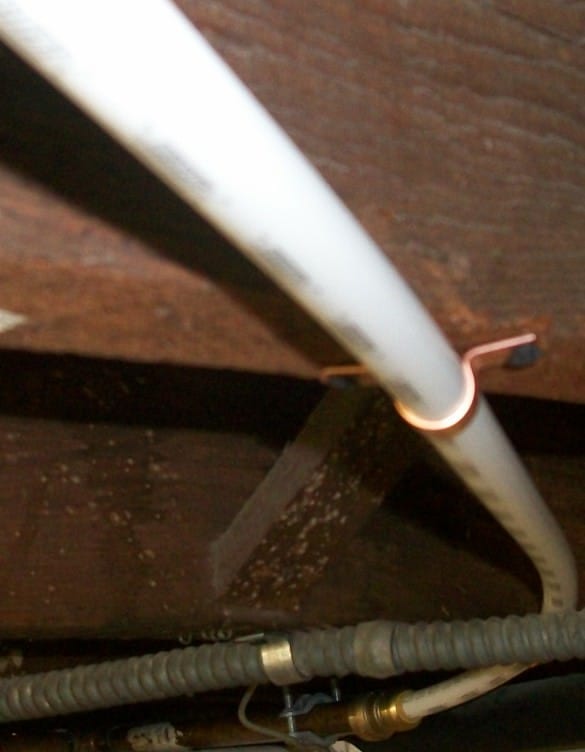 A pipe held to a joist by a small hook. Clamps like this every 4 to 6 feet, with a cushion under them, stop a pipe from knocking. Photo by Tomwsulcer via Wikimedia Commons, CC BY-SA 3.0, resized.
Fit an arrestor on the noisy fixture
Shut off the water to the fixture (at its shutoff valve), unscrew the supply hose, and thread the arrestor onto the faucet or valve, then re-attach the hose to the arrestor. Hand-tight plus a quarter turn is enough. The arrestor has a sealed air chamber with a piston that soaks up the pressure wave when the valve closes. For a dishwasher or washer, buy the hose-thread version made for appliances. Test by running the same cycle and listening for the bang.
Restore the air cushions in older homes
Houses built before about 1990 may have capped vertical pipes behind walls, called air chambers, that cushion the shock. Over time they fill with water and stop working. Shut off the main valve, open every faucet in the house, flush the toilets to drain the tank, and let the pipes empty for 10 minutes. Close all the taps, open the main slowly, and let the air chambers refill with air. It costs nothing and sometimes silences the noise entirely.
Time and Cost
| Fix | Time | Cost |
|---|---|---|
| Test pressure and strap loose pipes | 30–45 min | $13–$25 |
| Screw-on arrestor at one fixture | 15 min | $10–$20 |
| Drain the system to recharge air chambers | 30 min | $0 |
| Plumber replaces a pressure regulator | — | $300–$700 |
Why This Works
Water in a pipe has mass and speed. When a solenoid valve in a dishwasher closes in a fraction of a second, all of that moving water stops at once, and its momentum becomes a pressure spike that travels back through the pipe at the speed of sound in water. That spike is the bang. The shock is bigger at high static pressure, which is why a regulator check comes before anything else. An arrestor gives the spike somewhere to go: the water compresses a pocket of air or gas behind a piston, and the energy is absorbed instead of echoing through the walls. Strapping the pipe stops the leftover movement from becoming noise.
Mistakes to Avoid
- Ignoring pressure and just adding arrestors. If the pressure is 90 psi, you are masking a problem that wears out every fixture in the house. Measure it first.
- Buying the wrong size. Arrestors come sized by the number of fixture units and by thread type. Match the one for your appliance hose or the faucet supply.
- Overtightening a plastic fitting. A cracked arrestor leaks. Hand-tight plus a quarter turn.
- Clamping a pipe tight with no cushion. A bare metal strap against copper transmits noise and wears through the pipe. Use padded clamps or wrap the pipe.
If the bang started right after you adjusted something at the toilet, a toilet that runs after it fills may have a worn flapper or float. And weak pressure at the shower, the opposite problem, is covered in low shower water pressure.
FAQ
What causes water pipes to bang when the water is turned off?
Water hammer. Water flowing at speed has momentum, and when a valve slams shut, that moving water has nowhere to go and hits the closed valve, sending a pressure wave back through the pipes. Quick-closing valves in dishwashers and washing machines are the usual trigger, and loose pipes make the bang louder. High water pressure makes everything worse.
Is water hammer dangerous to my plumbing?
It can be. A mild knock is more annoying than harmful, but repeated hard bangs stress joints and can loosen fittings or crack old pipes over the years. If the noise is loud, getting louder, or paired with leaks at joints, fix it soon.
How do I stop water hammer without a plumber?
First check your water pressure with a $10 gauge on an outdoor spigot. Above 80 psi, the regulator needs attention. Then strap any loose pipes, and fit a screw-on water hammer arrestor on the supply line to the noisy fixture. In older homes, draining the system can also restore the air cushions that quiet the pipes.
How much does it cost to fix water hammer?
DIY, $5 to $60: a pressure gauge, pipe straps, and one or two arrestors. A plumber charges $150 to $400 for a visit that adds arrestors, or $300 to $700 if the pressure regulator needs replacing. Noise from pipes you can't reach inside walls is the usual reason to call.
Related fixes
Bathroom
Low Shower Water Pressure? Fix It in One Evening
Weak shower pressure is usually a mineral-clogged head, not your pipes. Soak it in vinegar, check the inlet screen, and know when it's something bigger.
Time20 min active + 1–2 hr soak Cost$2–$25 moderate
Bathroom
How to Fix a Running Toilet in 15 Minutes (No Plumber)
A running toilet is usually a worn flapper or misadjusted float. Diagnose it with a dye test and fix it yourself in 15 minutes for under $12.
Time15–30 min Cost$5–$18 easy


Bathroom
How to Replace a Toilet Fill Valve in 30 Minutes
A bad toilet fill valve hisses, refills slowly, or will not hold the water level. Shut off the supply, swap the valve, set the height, and test it.
Time30 min Cost$12–$20 moderate