Smoke Detector Chirping? Why a New Battery Didn't Fix It
Cover photo by 최광모 via Wikimedia Commons, CC BY-SA 4.0, resized.
If this fix touches water, gas, or power, the guide starts with the shutoff step and says when a licensed pro should take over.
Product links in this guide are affiliate links. If you buy through one, we may earn a small commission at no extra cost to you. It never changes which products we recommend.
The chirp starts around three in the morning, you swap the battery, and forty minutes later it chirps again. This is not a defective alarm and you are not going crazy. There are three common reasons a fresh battery doesn’t stop the noise, and two of them take under a minute once you know about them.
Quick Answer
If a smoke detector is chirping after a new battery, the unit is probably holding residual charge. Remove the battery, press and hold the test button for 15 to 20 seconds to drain the capacitor, then install the fresh battery. If it still chirps, check the manufacture date printed on the back: detectors expire ten years from that date and chirp at end of life, and no battery will ever silence one. Also confirm the chirp is coming from the alarm you think it is, since carbon monoxide detectors and other alarms in a linked chain sound nearly identical. Cost is a battery, or about $15 to $40 for a replacement unit.
What You’ll Need
- A fresh 9V or AA battery of the type your unit takes, from a package you just opened
- A step stool, not a chair
- A vacuum with a brush attachment, or a can of compressed air
- A replacement smoke alarm, $15–$40, if yours is at end of life
- A marker, for writing the install date on the new one
Step-by-Step
Confirm which device is actually chirping
Stand under it and wait for two or three chirps before you commit. Houses often have smoke alarms, a carbon monoxide detector, and sometimes a security panel or an alarm on a sump pump, and they all chirp similarly. In a hardwired interconnected system, one failing unit can trigger a chirp pattern that seems to come from elsewhere in the chain. Getting this wrong means changing batteries in a perfectly happy alarm.
Note the chirp pattern
A single chirp roughly every 30 to 60 seconds is the low-battery or end-of-life signal. Three or four loud repeating tones is an actual alarm and means get out of the house. Some units differentiate end-of-life with two chirps in a row or a distinct pattern, and the label on the back or the manual will tell you which. This is worth twenty seconds of attention because it separates a battery job from a replacement job.
Change the battery properly
Twist the unit off its mounting bracket and disconnect the harness if it is hardwired. Put in a fresh battery from a sealed package, not the one that has been rolling around a drawer since last winter. Make sure it seats fully and the door closes without resistance, since a battery that is slightly proud of its contacts produces exactly this symptom.
Drain the capacitor
Here is the step almost nobody knows. With the battery out and the unit disconnected from power, press and hold the test button for 15 to 20 seconds. You may hear a short weak chirp as the stored charge dissipates. That capacitor is what keeps the alarm alive briefly during a power blip, and it can hold enough charge to keep replaying the low-battery signal even with a fresh battery installed. Drain it, then reinstall the battery and remount the unit.
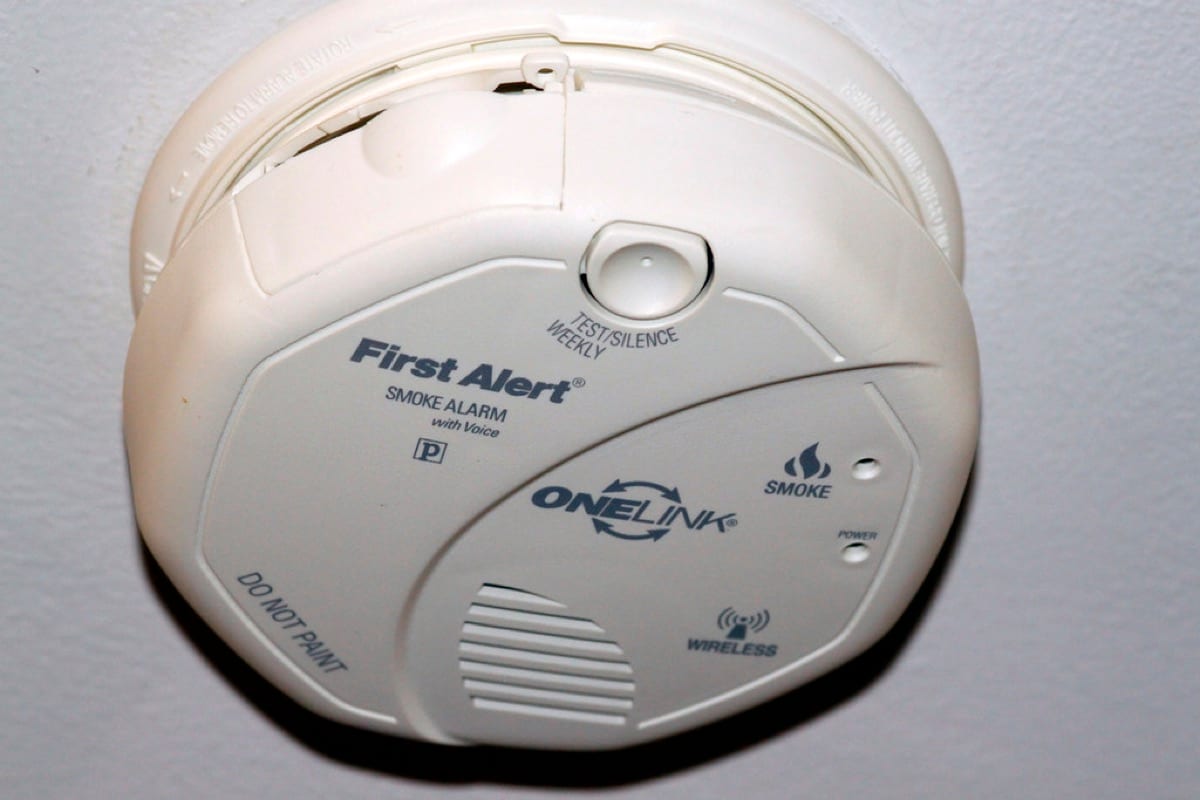 The Test/Silence button is the same one you hold for 15 to 20 seconds, battery removed, to drain the capacitor. Photo by Jenn Durfey via Flickr, CC BY 2.0, resized.
Check the manufacture date
Take the unit down and look at the back. There will be a printed date of manufacture, sometimes labeled “replace by” instead. If it is ten years old or more, that is your answer and no amount of battery swapping will help. The sensing chamber degrades on a schedule regardless of use, which is why manufacturers and fire codes both treat ten years as a hard limit rather than a suggestion. Replace it.
Clean the sensing chamber
Dust, cobwebs, and the occasional insect inside the chamber cause both nuisance chirps and false alarms. Vacuum the outside vents with a brush attachment, or blow compressed air through the slots from a few inches away. Do this every six months as routine, and especially after any drywall sanding or renovation work in the house.
Write the date on the new one
When you install a replacement, write the install date on the side with a marker. Ten years from now the chirp will start at three in the morning again, and the person standing on the stool will thank you for the thirty seconds this took.
Time and Cost
| Fix | Time | Cost |
|---|---|---|
| Battery and capacitor drain | 10 min | $3–$8 |
| Vacuum the sensing chamber | 5 min | $0 |
| Replace an expired unit | 20 min | $15–$40 |
| Replace a hardwired interconnected unit | 30 min | $25–$50 |
| Electrician for a hardwired chain fault | 1–2 hrs | $150–$300 |
Why This Works
A smoke alarm is designed to complain rather than fail silently, which is why it makes a noise you cannot ignore instead of just going dark. The low-battery chirp is triggered when supply voltage crosses a threshold, and two things move that threshold around. One is temperature: alkaline batteries lose a bit of voltage in the cold, so a marginal battery crosses the line in the small hours when the heating has been off longest. The other is the backup capacitor, which stores enough energy to run the alarm’s logic briefly on its own, and until that charge is drained the unit can keep announcing a condition that no longer exists. The ten-year expiry is a separate matter entirely, driven by the slow degradation of the sensing element, and it is the one failure a battery genuinely cannot address.
Mistakes to Avoid
- Pulling the battery and leaving it out. The most dangerous shortcut in this article. If you need silence tonight, buy a replacement tomorrow morning and mark it on your calendar tonight.
- Assuming the chirp means the battery. After ten years the unit chirps because it is finished, and you can put a hundred dollars of batteries through it without changing anything.
- Changing one alarm in an interconnected system. If they are wired together and one is at end of life, the others are the same age. Replace the set.
- Painting over a smoke alarm. It blocks the vents and disables the sensing chamber, and it happens more often than you would expect during a repaint.
- Mounting one right beside a bathroom or over the stove. Steam and cooking smoke cause nuisance alarms, which lead to people disabling them, which is the actual hazard.
While you’re up on the stool with the electrical odds and ends, two other five-minute checks pay off: knowing why a GFCI won’t reset and how to reset a tripped breaker properly cover the two calls electricians get most often for problems that were never really faults.
FAQ
Why does my smoke detector keep chirping after I changed the battery?
Residual charge is still held in the unit. Pull the battery out, then press and hold the test button for about 15 to 20 seconds to drain the capacitor, then put the fresh battery back in. If it still chirps after that, check the manufacture date on the back, because a detector past ten years chirps to tell you it has expired.
How long do smoke detectors last?
Ten years from the date of manufacture, not the date you installed it. The sensing element degrades whether the alarm is used or not, which is why replacement is mandatory rather than optional. Every unit has the manufacture date printed on the back, and after ten years the alarm chirps at end of life and no battery will stop it.
Why does my smoke detector chirp in the middle of the night?
Because the temperature drops. Cold air lowers battery voltage slightly, and a battery already near the low-power threshold crosses it around 3 or 4 a.m. when the house is coldest. It is one of the more reliably annoying facts about the device, and it means the battery is genuinely low even if it worked fine all day.
Can I just take the battery out to stop the noise?
Please don't. A disabled smoke alarm is how most fatal house fires happen in homes that had alarms installed. If you need immediate quiet, pull the battery and replace the unit the same day, and put a note on the door so nobody forgets. A basic replacement is around $15.
Related fixes
Electrical
How to Fix a Dead Outlet Before Calling an Electrician
A dead outlet is often a tripped GFCI, breaker, or switched receptacle. Check the safe resets first, then know when wiring needs a pro visit.
Time5–15 min Cost$0–$12 easy

Electrical
How to Reset a Tripped Breaker the Right Way
A tripped breaker often looks like it's still on. Push it fully to off first, then back on, and learn the difference between a nuisance trip and overload.
Time5–10 min Cost$0–$15 easy