Seal Drafty Windows Before the First Cold Snap

Cover photo by hassan jafari via Wikimedia Commons, CC BY 3.0, resized.
If this fix touches water, gas, or power, the guide starts with the shutoff step and says when a licensed pro should take over.
Product links in this guide are affiliate links. If you buy through one, we may earn a small commission at no extra cost to you. It never changes which products we recommend.
Nobody thinks about windows in August, which is exactly why August is the right time. Sealing work goes faster in mild weather, the materials stick properly above 50 degrees, and you get to do it once instead of scrambling with a roll of tape the first genuinely cold week. The work is simple. Finding the actual leak is the part worth doing carefully.
Quick Answer
To seal drafty windows, find the draft first, then match the fix to where it is. Use a smoking incense stick around the window perimeter on a windy day to see where air moves. Gaps between the sash and frame take weatherstripping or rope caulk. Gaps between the frame and the wall take caulk. Cold rolling off the glass itself takes window insulation film, which is the cheapest real improvement on an old single-pane window at about $3 per window. Never seal the weep holes along the bottom exterior of a vinyl frame. Expect $10 to $45 per window and an afternoon.
What You’ll Need
- Incense sticks, or a stick of lit punk, for finding leaks
- Foam or V-strip weatherstripping, $8–$15 a roll
- Rope caulk, around $6, for temporary seasonal sealing
- Window insulation film kit, $15 for five windows
- Exterior caulk and a caulk gun for frame-to-wall gaps
- A hair dryer, for shrinking the film tight
Step-by-Step
Find the leaks properly
Pick a windy day. Close the interior doors of the room and switch on the bathroom or kitchen exhaust fan, which drops the pressure slightly and pulls outside air in through every gap. Light an incense stick and move it slowly around the window, two or three inches out, watching the smoke. Where it bends, curls, or scatters, you have a leak. Mark each one with a bit of painter’s tape. Doing this before you buy materials means you seal the gaps you have rather than the ones you assumed.
Seal the sash gaps
Air coming through where the moving sash meets the frame is the most common finding on older double-hung windows. Clean the surfaces with rubbing alcohol so the adhesive holds, then apply foam tape or a V-strip along the contact surface. V-strip is better on the sliding faces because it springs open against the sash instead of being crushed flat, so it keeps sealing over years rather than months. Test that the window still closes and latches, since too thick a strip stops it from seating and makes the draft worse.
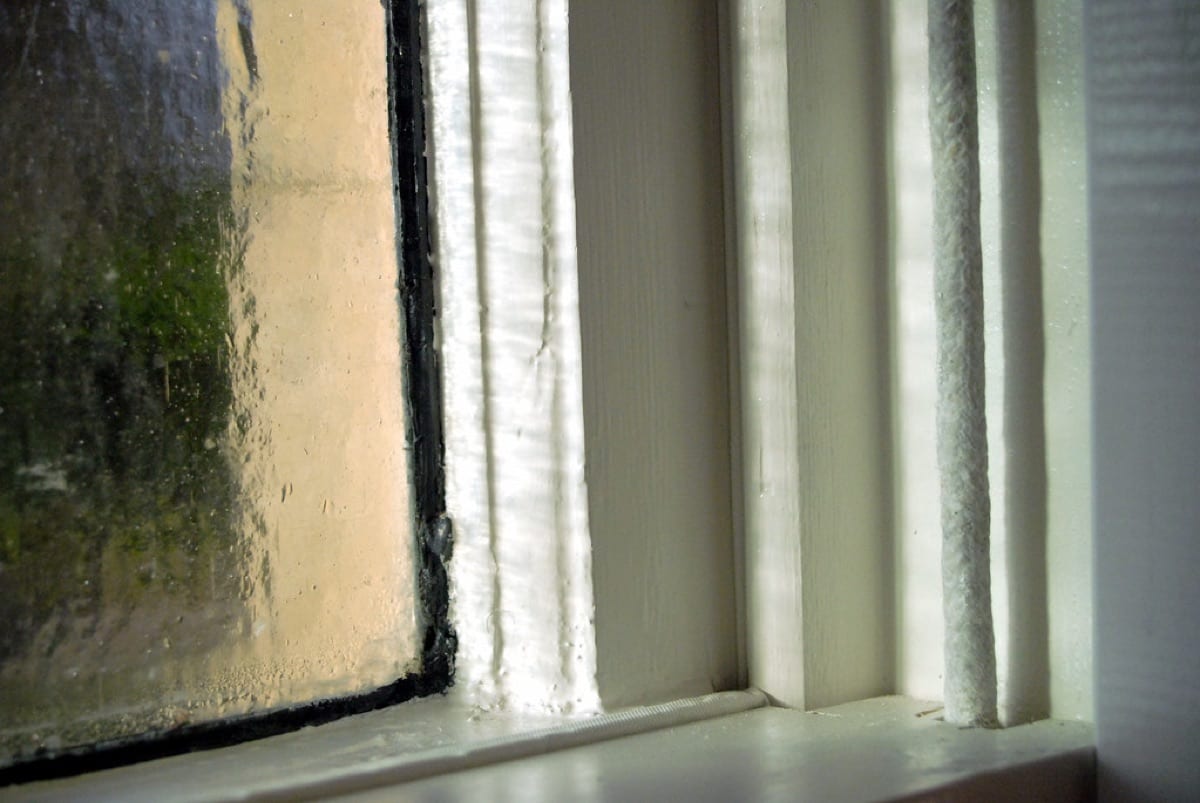 Condensation collecting on cold single-pane glass next to the sash seal. The water is the symptom of warm room air hitting a cold surface, which is the problem film solves and weatherstripping does not. Photo by williefogg via Flickr, CC BY 2.0, resized.
Rope caulk the windows you never open
For a window that stays shut all winter, rope caulk is quicker and more effective than tape. Press the putty-like rope into the seam between sash and frame with your thumb, and it fills irregular gaps that no uniform strip can. It peels off cleanly in spring and can often be reused. This is the standard fix for the upper sash of a double-hung, which almost nobody opens anyway.
Caulk the frame-to-wall gap
This gap is outside the window unit and is a genuine hole in the building. Inside, run a bead of paintable caulk where the trim meets the wall. Outside, use exterior-grade caulk where the frame meets the siding or brick. Clean out failed old caulk first rather than laying new over it. This is often the biggest single leak on a window and the one people overlook, because it hides behind trim and looks like a construction detail rather than a defect.
Leave the weep holes alone
Look along the bottom of the exterior of a vinyl window frame and you will find small slots or holes. Those are weep holes, and they exist to drain rainwater that works its way into the frame track. Sealing them, which people do constantly while caulking, traps water inside the frame where it has nowhere to go except into the sill and the wall below. Every one of those holes stays open. If a hole is blocked with dirt, clear it with a toothpick.
Put film on the worst windows
Insulation film is unglamorous and it works. Run the double-sided tape around the frame, stretch the film across it, then shrink it drum-tight with a hair dryer until the wrinkles pull out and it becomes nearly invisible. What it does is trap a still layer of air against the glass, and still air is the actual insulator. It also stops the convection current where air cools against cold glass and pours down onto the floor, which is a large part of what people feel as a draft. On single-pane windows the difference is genuinely noticeable.
Consider the cheap non-permanent options
A heavy curtain or a cellular shade closed at dusk cuts the same convection current, and a draft snake along the sill catches what leaks at the bottom. Neither is a repair, both help, and both take about a minute a day.
Time and Cost
| Fix | Time | Cost |
|---|---|---|
| Weatherstrip a sash | 20–30 min | $8–$15 per roll |
| Rope caulk a fixed sash | 10 min | $6 |
| Caulk the frame-to-wall gap | 30 min | $8–$12 |
| Insulation film, five windows | 1–2 hrs | $15 |
| Replacement window, installed | half day each | $450–$1,200 each |
Why This Works
Cold windows make a room uncomfortable in two separate ways, and they need two separate fixes. The first is air leakage, real outside air coming through gaps, driven by wind pressure and by the stack effect that pulls air in low and pushes it out high in any heated building. Weatherstripping and caulk address that by closing the openings. The second is radiant and convective loss through the glass itself, where no air moves at all but warm room air touching cold glass cools, gets denser, and slides down onto the floor as a draft that feels exactly like a leak. Film fixes that one by holding a layer of air still against the pane, which is why it helps even on a window that is perfectly airtight.
Mistakes to Avoid
- Caulking the weep holes. The single most damaging error here. It converts a draft into a slow rot in the sill, and you will not see it for years.
- Sealing a window shut that you need in an emergency. At least one window per bedroom has to open. Do not weatherstrip or film an egress window closed.
- Applying adhesive weatherstripping to a dirty or cold surface. It falls off by January. Clean with alcohol and work above 50 degrees, which is the argument for doing this now.
- Buying replacement windows to fix drafts. They work, but $450 to $1,200 per window against $20 of weatherstripping is a very long payback. Replace rotted frames, not draft complaints.
- Sealing everything without any ventilation plan. A very tight house needs deliberate ventilation, and running the bathroom and kitchen exhaust fans matters more once the leaks are gone.
Windows and doors leak for the same reasons, and the two jobs pair naturally on the same afternoon. The door version is covered in fixing a drafty door, and the gap under the door specifically is a door sweep problem. While you’re already thinking about the cold months, clearing the gutters belongs on the same list.
The same October weekend is when the outdoor spigots need their hoses off and their lines drained. Winterizing outdoor faucets is the cheapest insurance on the list.
FAQ
How do I find where a window is leaking air?
Light an incense stick on a windy day and move it slowly around the window perimeter, a couple inches from the frame. The smoke will bend or scatter where air moves. Close interior doors and run the bathroom exhaust fan first to slightly depressurize the room, which pulls outside air in harder and makes small leaks obvious.
Does window insulation film actually work?
Yes, more than people expect, especially on old single-pane windows. The film traps a still air layer against the glass, which is what actually insulates, and it also stops the cold draft that rolls off cold glass down onto your feet. A kit covering five windows costs about $15 and is the best return per dollar on this list.
Should I caulk around the inside of my windows?
Caulk the gap between the window frame and the wall, yes. Never caulk the moving parts of the sash, and never seal the small weep holes along the bottom of a vinyl frame's exterior. Those holes let rainwater that gets into the frame drain back out, and blocking them traps water inside the frame where it rots the sill.
Is it cheaper to seal old windows or replace them?
Seal them, in almost every case. Weatherstripping, caulk, and film run $10 to $45 per window and recover most of the draft. Replacement windows cost $450 to $1,200 each installed and typically take decades to pay back in energy savings alone. Replace when frames are rotted or sashes no longer close, not to chase efficiency.
Related fixes

Outdoors & Seasonal
Fix a Drafty Door in an Hour (Weatherstripping That Lasts)
That draft under the front door costs real heating and AC money. Find the gaps with a flashlight, then seal them with $15 of weatherstripping and a sweep.
Time45–60 min Cost$10–$25 easy
.jpg)
Outdoors & Seasonal
How to Replace a Worn Door Sweep Before Winter
If cold air comes in under the door, the sweep is probably torn or missing. Replace it in 20 minutes for $8–$15 and stop the floor-level draft.
Time20 min Cost$8–$15 easy