How to Fix a Door That Won't Latch or Stay Closed
Cover photo by Infrogmation of New Orleans via Wikimedia Commons, CC BY 2.0, resized.
If this fix touches water, gas, or power, the guide starts with the shutoff step and says when a licensed pro should take over.
Product links in this guide are affiliate links. If you buy through one, we may earn a small commission at no extra cost to you. It never changes which products we recommend.
You push the door shut and it drifts back open. Push harder and the bolt scrapes, clicks, and sometimes holds. A door that refuses to latch is a measuring problem: the latch bolt and the hole it’s meant to drop into have moved apart, usually by less than a quarter inch. Find the direction, move one of them, and the door closes with a clean click again.
Quick Answer
When a door won’t latch, the fix is finding where the bolt hits the strike plate and moving one of them. Rub lipstick or a marker on the end of the bolt, close the door normally, and look at the mark on the plate. A miss of 1/8 inch or less gets the strike opening widened with a metal file in that direction, ten minutes. A bigger miss means moving the plate: plug the old screw holes with glued toothpicks, chisel the mortise, and reset it. If the mark is low, the door has sagged, so drive a 3-inch screw through the top hinge into the framing to pull it back up before you touch the plate. A bolt that doesn’t spring out at all gets dry lubricant or a $10 latch. Total cost $0 to $12.
What You’ll Need
- Lipstick, a dry-erase marker, or chalk, to mark where the bolt lands
- A half-round metal file, $8–$12, for widening the strike opening
- Two 3-inch wood screws, for pulling a sagging hinge back into the framing
- Wooden toothpicks or golf tees and wood glue, for plugging old screw holes
- A sharp chisel and a utility knife if the plate has to move
- A dry lubricant spray with a straw, $6–$9, for a sticky latch bolt
Step-by-Step
Mark the bolt and read the miss
Coat the end of the latch bolt with lipstick or chalk. Close the door the way you normally would, once, and open it. The smear on the strike plate shows exactly where the bolt lands. Above the opening, below it, or toward the door stop: that’s the direction you need to move the opening, or move the door. Measure the miss against the edge of the opening. Under 1/8 inch is a file job. More than that is a relocation or a hinge fix. Nothing else in this guide makes sense until you’ve done this one-minute test.
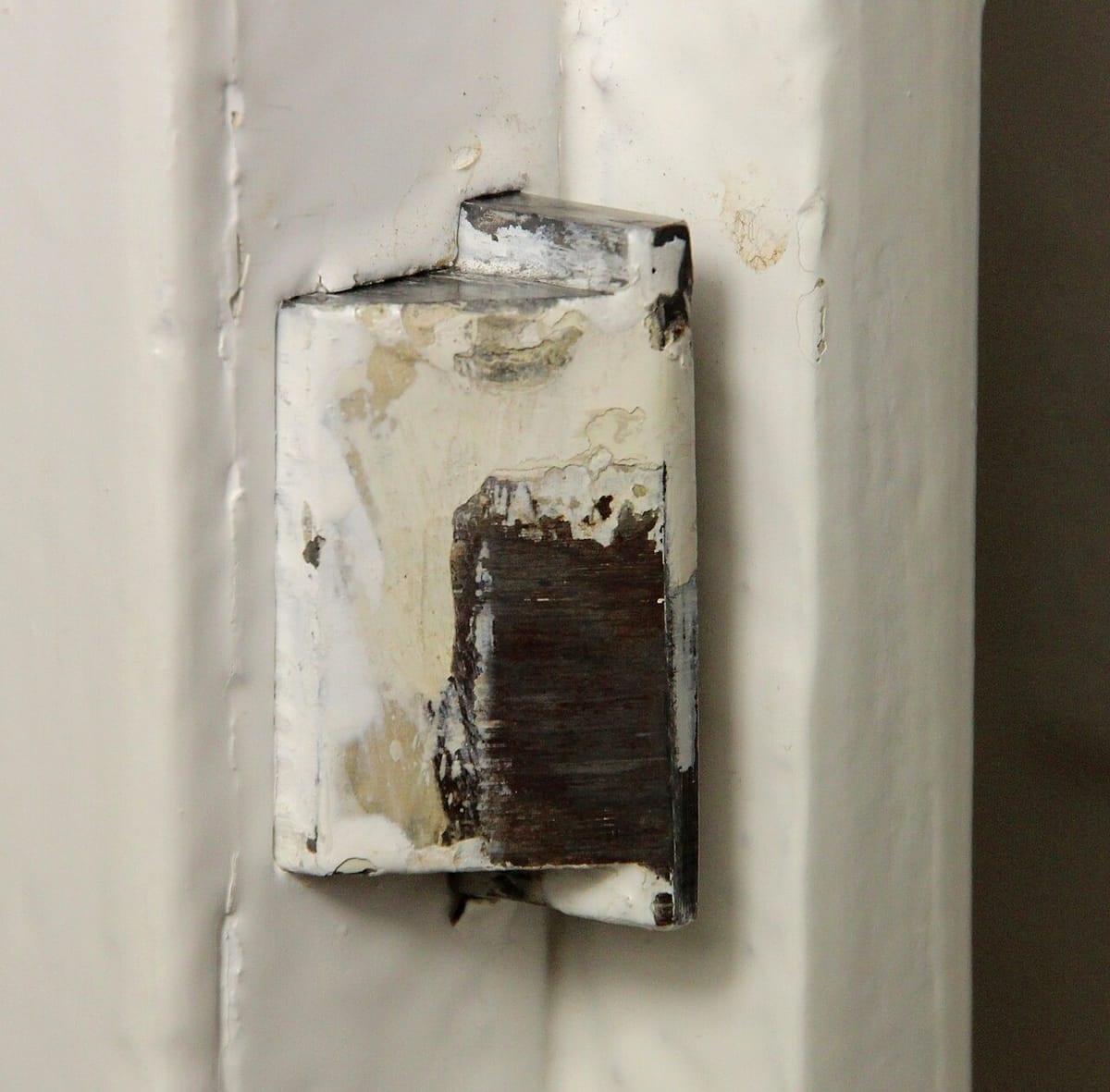 The latch bolt. Its beveled face rides over the strike plate’s lip on the way in, and its square shoulder is what holds the door shut. Photo by Frank C. Müller via Wikimedia Commons, CC BY-SA 4.0, resized.
Pull up a sagging door first
If the mark is low, the door has dropped on its hinges, and filing the strike would only hide that for a season. Open the door, remove one screw from the top hinge on the jamb side, and drive a 3-inch screw in its place. It bites through the jamb into the stud and pulls the whole door up and in. Check the gap along the top of the door: it should be even. A door that also rubs the jamb usually needs the same screw plus a little planing, and a hinge that squeaks while you’re there takes 30 seconds. Re-mark the bolt after the screw goes in. Often the miss is gone.
File the strike opening for a small miss
Unscrew the strike plate (two screws), clamp it in a vise or hold it on a scrap board, and file the edge of the opening in the direction of the miss. Take off 1/16 inch, screw it back, test with the lipstick again, and repeat. Filing the plate in place works too, if you’re careful not to chew the jamb. The bolt should drop into the opening with a solid click, and the door should resist a push from the inside without rattling. Stop as soon as it holds. Every stroke past that adds rattle.
Move the plate for a bigger miss
Remove the plate. Dip toothpicks in wood glue, pack them into the old screw holes, snap them flush, and let the glue set for 20 minutes. Hold the plate in its new position, trace it with a utility knife, and chisel the mortise out to the line, just deep enough that the plate sits flush. Drill small pilot holes and screw the plate in. The part of the old mortise now showing gets wood filler, a light sand, and paint. Close the door: the bolt should land in the center of the opening.
Free a sticky latch bolt
If the bolt doesn’t spring out fully, or sticks when the knob is released, the latch mechanism is dry or gummed. Push the bolt in with a finger: it should pop back out instantly. Spray dry lubricant (graphite or PTFE, never oil) into the bolt opening on the door edge and around the bolt, work the knob 20 times, and wipe the excess. A bolt that stays sluggish, or a knob that turns without moving the bolt, means the latch is worn out. Two screws on the edge plate release it, and a replacement is $8 to $15.
Time and Cost
| Fix | Time | Cost |
|---|---|---|
| Lipstick test and file the strike | 15 min | $0–$12 |
| 3-inch screw in the top hinge | 5 min | $0 |
| Move the strike plate | 45 min | $2 |
| Replace the latch | 15 min | $8–$15 |
| Handyman adjusts a door | — | $75–$150 |
Why This Works
A latch holds a door because a spring-loaded bolt drops into a hole in the strike plate with a square shoulder that can’t be pushed back without turning the knob. The bolt’s beveled face lets it ride over the plate’s edge on the way in, but only if the opening is where the bolt arrives. Wood moves. Humidity swells a door in summer, framing settles over years, and screws in a top hinge loosen a few thousandths at a time as the door’s weight hangs on them. A quarter inch of sag at the hinge pin becomes a quarter inch of drop at the latch, three feet away. Every fix here either returns the door to where the opening is or moves the opening to where the door now lands.
Mistakes to Avoid
- Filing the strike before fixing the sag. The door keeps dropping, and in six months you’re filing again with a bigger hole. Hinge screw first.
- Oiling the latch. Household oil attracts dust and gums the mechanism within weeks. Dry lubricant only.
- Reusing the old screw holes a quarter inch over. The screws walk back into the old holes and the plate slides. Plug them, let the glue cure, drill fresh pilots.
- Bending the strike plate’s tongue to “tighten” the door. It fixes a rattle for a week, and then the bolt hangs up on the bent tongue, which is a worse version of the original problem. Adjust the opening instead.
Once the door closes clean, check the gap at the bottom. A door that latches but shows daylight underneath needs a new sweep, which is the other half of a tight exterior door.
FAQ
Why does my door not latch anymore?
The door has moved relative to the strike plate. Houses settle, hinge screws loosen, humidity swells the door, and a sagging door drops its latch bolt below the strike opening by a hair. Nothing on the latch itself usually failed. The fix is finding which direction the bolt misses, with a lipstick mark, and then moving either the plate or the door by that amount.
How do you adjust a strike plate on a door?
For a miss under 1/8 inch, widen the strike opening with a half-round metal file in the direction the bolt needs to go. For a bigger miss, remove the plate, plug the old screw holes with glued toothpicks or a dowel, chisel the mortise toward the new position, and screw the plate back in its new spot. Fill the exposed part of the old mortise with wood filler and paint.
Can I fix a door latch without replacing it?
Almost always. A latch bolt that's sticky or won't spring out gets a shot of dry lubricant into the mechanism through the bolt opening, never oil, which gums it up. A bolt that sticks out but doesn't reach the strike is an alignment problem, not a latch problem. Replacement is only for a bolt that's broken off or a spring that no longer pushes it out at all, and a new latch is $8 to $15.
Why does my door pop open on its own?
The bolt is catching on the edge of the strike opening instead of dropping fully into it, so any pressure or a draft pushes it back out. Look at the strike plate for a shiny wear mark on its edge. File the opening so the bolt seats fully, or move the plate a hair toward the stop so the door closes tighter against the weatherstripping.
Related fixes

Walls, Doors & Floors
How to Fix a Sticking Door (Tighten the Hinges First)
Most sticking doors are sagging, not swollen. One long screw in the top hinge pulls the door back square, and it costs about fifty cents to try.
Time20–60 min Cost$0–$15 easy
Walls, Doors & Floors
Fix a Squeaky Door Hinge for Good (WD-40 Isn't Enough)
WD-40 quiets a hinge for a week. Pulling the pin and coating it with silicone or lithium grease fixes it for years. Here is the 5-minute method.
Time5 min per door Cost$6–$8 easy


Outdoors & Seasonal
How to Replace a Worn Door Sweep Before Winter
If cold air comes in under the door, the sweep is probably torn or missing. Replace it in 20 minutes for $8–$15 and stop the floor-level draft.
Time20 min Cost$8–$15 easy