How to Stop a Washing Machine Shaking During Spin
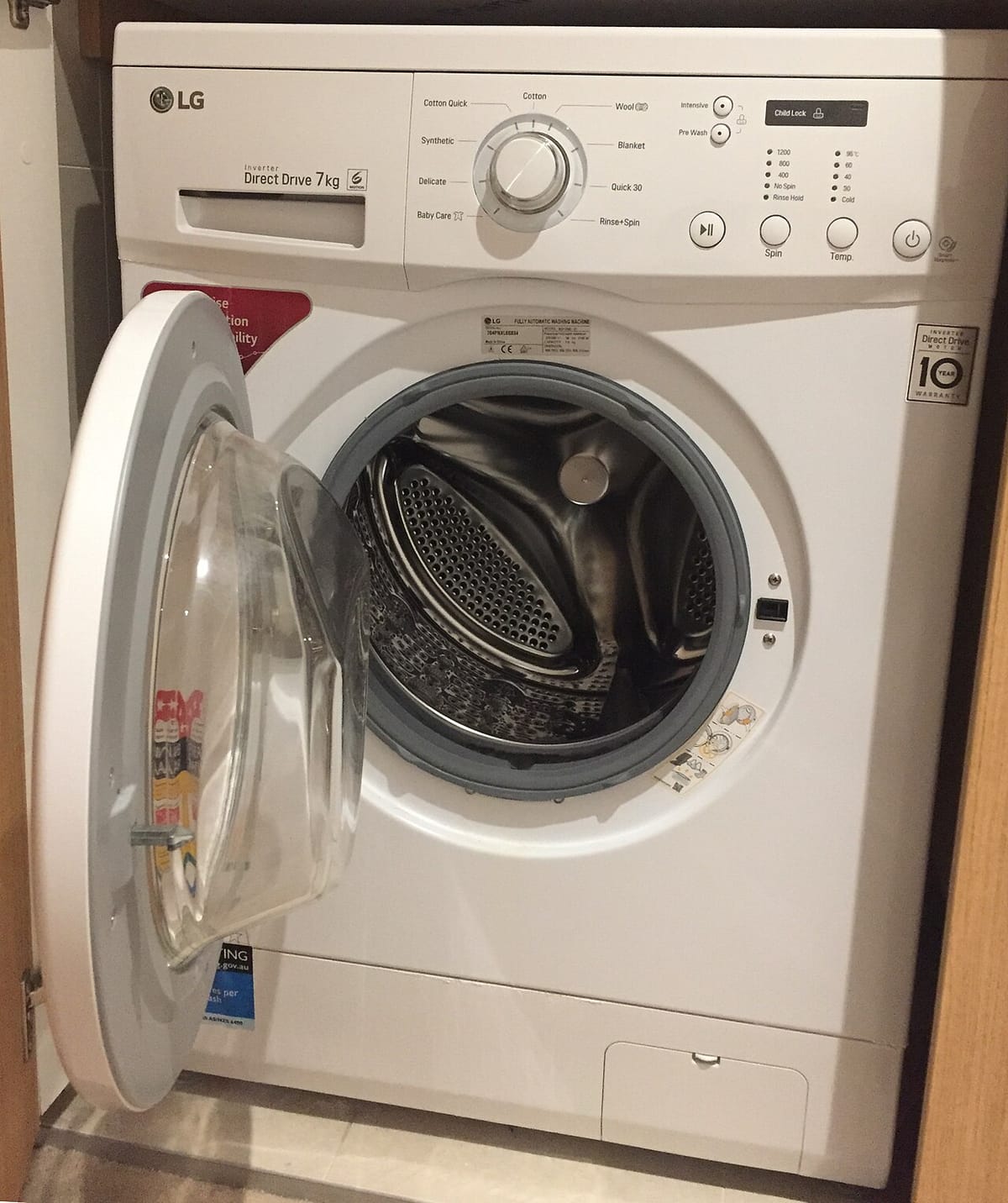
Cover photo by Gb.select via Wikimedia Commons, CC BY-SA 4.0, resized.
If this fix touches water, gas, or power, the guide starts with the shutoff step and says when a licensed pro should take over.
Product links in this guide are affiliate links. If you buy through one, we may earn a small commission at no extra cost to you. It never changes which products we recommend.
From the kitchen it sounds like someone is throwing the washer down the stairs. By the time you get there it has banged itself six inches out of its alcove and it’s still going. A washer that shakes on spin is rarely broken. Something is either loading it lopsided, holding it rigid, or letting it rock, and you can tell which in about two minutes without a single tool.
Quick Answer
A washing machine shaking violently on spin has one of four causes, and you check them cheapest first. One: a lopsided load, like a single comforter or a pair of jeans in a big drum, so pause the cycle and redistribute. Two: the machine isn’t level, so put a bubble level on the cabinet, adjust the threaded feet until it sits solid, and lock the lock nuts. Three: on a machine less than a few months old, the shipping bolts are still locking the drum to the cabinet, and they come out of the back panel in ten minutes. Four: with all of that ruled out and an empty drum still banging, the suspension is worn, and that’s the repair-quote stage. The first three cost $0 to $30.
What You’ll Need
- A bubble level, $5–$10
- An adjustable wrench or pliers for the feet and lock nuts
- A socket set for shipping bolts (commonly 12–14 mm)
- Anti-vibration pads, $15–$25, for machines on wood-framed floors
- A helper or an appliance dolly if the machine must come forward
Step-by-Step
Rule out the load first
Stop the cycle mid-shake, open the lid or door, and look at how the laundry sits. One heavy waterlogged item wrapped around the agitator or plastered to one side of the drum will throw even a perfect machine into a gallop. Untangle it, spread the weight around the drum, and add a couple of towels if you’re washing a single bulky item. Restart the spin. If the machine now runs quietly, it was never broken, and the fix is a habit: wash comforters with company.
Push-test the corners
With the machine off, press down hard on each front corner, then each back corner. A machine that’s sitting right feels like pushing on a parked car. Any corner that dips and rebounds, or a machine that rocks diagonally, has a foot off the floor, and on spin that gap becomes a hammer. This ten-second test separates “adjust the feet” from “look deeper” before you touch a wrench.
Level the feet and lock them
Loosen the lock nuts, set the level across the cabinet top, and thread each front foot up or down until the bubble centers both side to side and front to back. Keep the machine as low to the floor as leveling allows, since tall extended feet wobble more. Many machines have self-adjusting rear feet that set themselves when you tilt the machine forward onto its front feet and set it back down. Finish by snugging every lock nut up against the cabinet. The expected result: the push test now moves nothing.
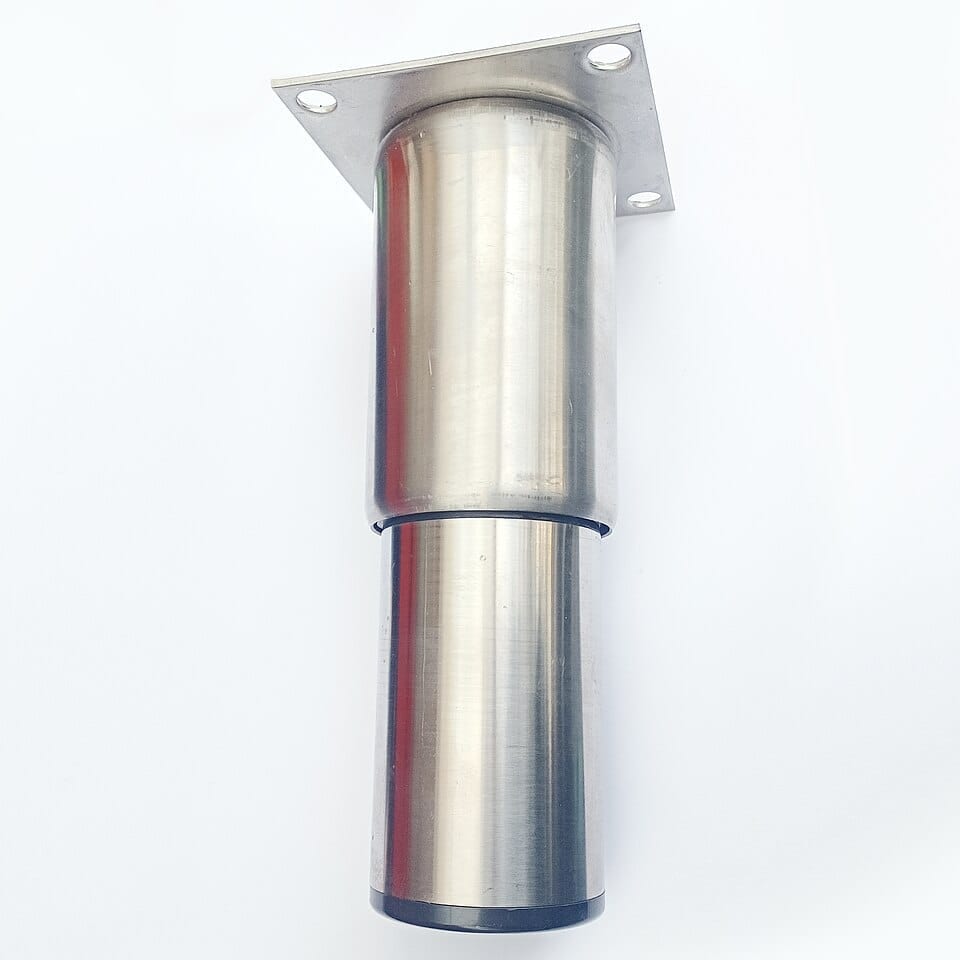 An adjustable appliance foot. The lower section threads in and out to meet the floor. Photo by acosta.eu via Wikimedia Commons, CC BY 4.0, resized.
Check for shipping bolts on a newer machine
If the machine is new to you, look at the back panel for three to five large bolts in a row, often with plastic spacers, around where the drum sits. Those are transit bolts, installed at the factory to keep the drum from destroying itself in the delivery truck, and they must come out before the first wash. Unscrew them with a socket, pull the plastic spacers, and snap the little cover plugs (usually taped inside the drum or door) into the holes. Keep the bolts. You’ll want them if the machine ever moves house again. An empty rinse-and-spin afterward should sound completely different.
If it still bangs empty, price the suspension
Level machine, empty drum, still banging: the parts that absorb drum motion are worn out. Top-loaders hang the tub on four suspension rods, front-loaders sit the drum on shock absorbers, and both are $30–$60 in parts with a fair amount of disassembly. A metallic grinding or roaring during spin on top of the shake points at the drum bearing instead. This is the honest hand-to-a-pro point for most people: get a repair quote, and if the machine is past ten years old, weigh the quote against replacement before authorizing it.
Time and Cost
| Fix | Time | Cost |
|---|---|---|
| Redistribute the load | 2 min | $0 |
| Level and lock the feet | 20 min | $0 |
| Remove shipping bolts | 10 min | $0 |
| Anti-vibration pads under the feet | 10 min | $15–$25 |
| Suspension rods or shocks, pro install | 1–2 hrs | $200–$400 |
Why This Works
A spin cycle turns the drum into a spinning mass at 800 to 1,400 RPM, and physics only forgives that if the mass is centered and the cabinet can’t move. An off-center load moves the spin axis away from the drum’s center, which produces a rotating force the suspension has to soak up on every revolution. A machine that rocks on an unlevel floor gives that force a direction to escape, and each oscillation feeds the next, which is why the walking gets worse through the cycle rather than better. Shipping bolts are the extreme case: they bypass the suspension entirely and feed the full force into the cabinet and your floor. Every fix on the list is the same idea from a different angle, either re-centering the mass or taking away its ability to move the box around it.
Mistakes to Avoid
- Wedging cardboard or shims under a corner instead of adjusting the feet. Shims pound loose within a few loads and leave you worse than level. The threaded feet exist for exactly this.
- Leveling the feet but skipping the lock nuts. Vibration spins unlocked feet out of adjustment in a couple of weeks, and the shake “mysteriously” returns.
- Washing one comforter alone because it fills the drum. Full isn’t balanced. Wet down, it becomes a single ten-pound lump on one side. Add towels or use a laundromat’s oversize machine.
- Blaming the machine when the floor is the problem. On a bouncy wood-framed floor, even a healthy washer shakes the room. Anti-vibration pads help, moving the machine against a load-bearing wall helps more, and a pedestal-mounted front-loader on joists mid-span may never be fully quiet.
While the machine is pulled out for leveling, it’s a good moment for two other five-minute jobs: clearing the drain filter and wiping down the door gasket you normally can’t reach.
FAQ
Why does my washing machine shake violently on the spin cycle only?
Spin is the only part of the cycle where the drum reaches hundreds of RPM, so it's where any imbalance shows up. The usual causes, in order: a lopsided load like one soaked comforter, feet that aren't level on the floor, shipping bolts left in a new machine, and worn suspension. Redistribute the load first, since that costs nothing and fixes the one-time shakes.
Did I ruin my new washer by running it with the shipping bolts in?
A cycle or two usually doesn't, but don't run another one. The bolts lock the drum rigidly to the cabinet so the suspension can't absorb anything, and the violent slamming you heard was the whole machine taking the force. Remove the bolts from the back panel with the wrench that shipped in the drum or a socket, run a rinse-and-spin empty, and listen: if it now runs smooth, you're fine.
How do I level a washing machine that keeps walking?
Loosen the lock nuts on the front feet, set a level on top of the cabinet, and thread the feet up or down until the bubble centers side to side and front to back, with the machine sitting as low as possible. Then push down on each corner. Any rocking means one foot is off the floor. Tighten the lock nuts when it sits dead solid, because unlocked feet vibrate out of adjustment in weeks.
When is a shaking washer worth a repair call?
When a level, balanced machine on a solid floor still bangs with an empty drum. That points to worn suspension rods or shock absorbers, roughly $30 to $60 in parts but a teardown to install, or a failing drum bearing, which usually growls during spin too. At $200 to $400 for suspension work, get a quote and weigh it against the machine's age.
Related fixes

Laundry & Cleaning
Washing Machine Smells? Clean These 3 Spots (Gasket, Drum, Filter)
A musty front-loader means mold in the door gasket and a clogged drain filter. Clean all three problem spots in 30 minutes and keep the smell away.
Time30 min + one wash cycle Cost$0–$10 easy


Laundry & Cleaning
Washer Won't Drain? Check the Filter, Hose, Then Pump
A washer full of standing water is usually a coin trap packed with lint or a kinked drain hose. Both are free fixes you can do in half an hour.
Time30–60 min Cost$0–$40 moderate