Garbage Disposal Not Working? Humming vs Silence
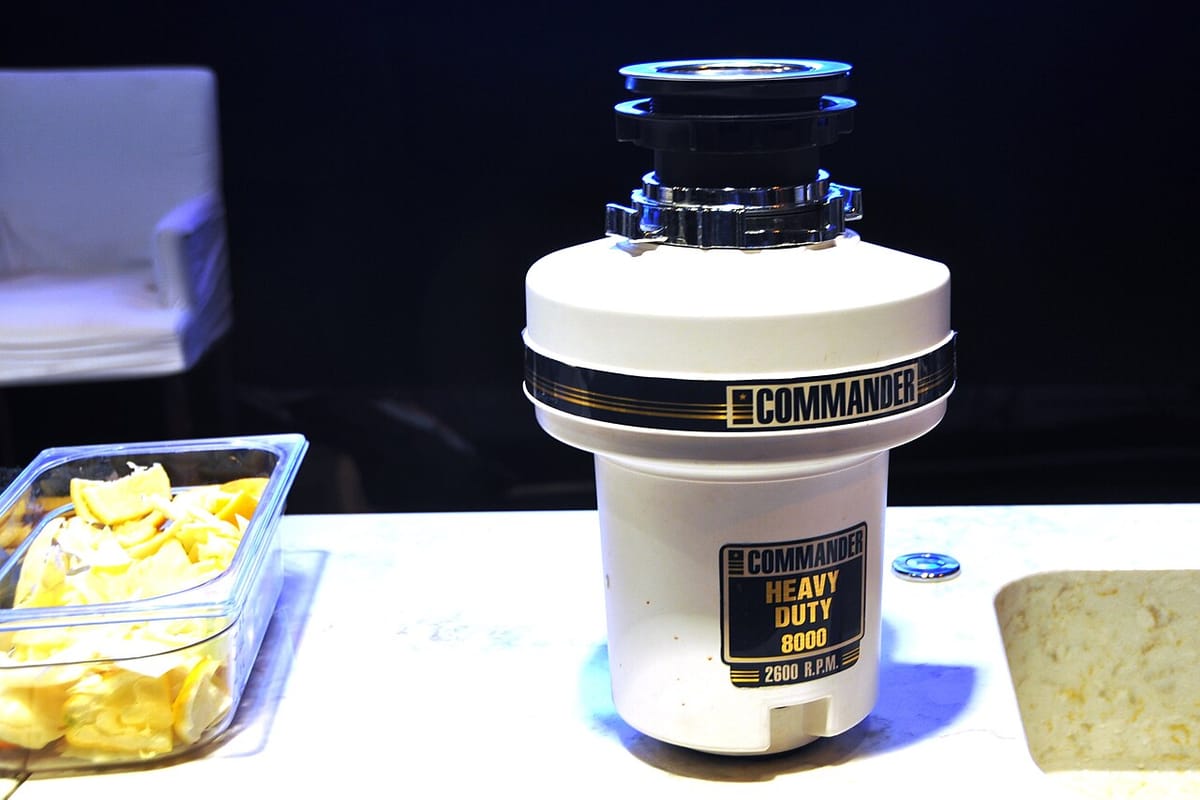
Cover photo by S.J. de Waard via Wikimedia Commons, CC BY-SA 3.0, resized.
If this fix touches water, gas, or power, the guide starts with the shutoff step and says when a licensed pro should take over.
Product links in this guide are affiliate links. If you buy through one, we may earn a small commission at no extra cost to you. It never changes which products we recommend.
Flip the switch and nothing happens. What that “nothing” sounds like tells you exactly what’s wrong, and it splits into two completely different repairs. A disposal that hums has a mechanical jam. A disposal that sits there in silence has an electrical problem. Almost everyone tries the fix for the wrong one first.
Quick Answer
A garbage disposal not working splits two ways. If it hums when you flip the switch, the motor has power and the grinding plate is jammed. Cut the power, put a quarter-inch hex wrench into the socket on the underside of the unit, and work it back and forth until the plate spins freely. If the disposal is completely silent, the thermal overload has tripped: press the small red reset button on the bottom of the unit until it clicks and stays in. Both fixes take under ten minutes and cost nothing. If neither works, check the breaker and the switched outlet under the sink before you assume the motor is dead.
What You’ll Need
- The hex wrench that shipped with the disposal, taped to the unit or in a kitchen drawer. If it’s long gone, any quarter-inch hex wrench set runs about $8
- Needle-nose pliers or long tongs for pulling out whatever caused the jam
- A flashlight
- A broom handle, as a backup lever if the hex socket is stripped
Step-by-Step
Kill the power before anything else
Switch the disposal off at the wall, then unplug it under the sink, or shut off its breaker if it’s hardwired. The wall switch alone is not enough. A jam that frees itself while the unit is energized will spin instantly, and every warning about this appliance exists because someone learned it the fast way. Nothing goes into the chamber, no hand and no fingers, at any point in this job.
Look before you reach
Shine the flashlight down into the chamber and fold back the rubber splash guard. Nine times out of ten the culprit is visible: a bottle cap, a peach pit, a chunk of bone, a teaspoon that fell in three days ago. Pull it out with the pliers or tongs. Sometimes that alone frees the plate and you’re done.
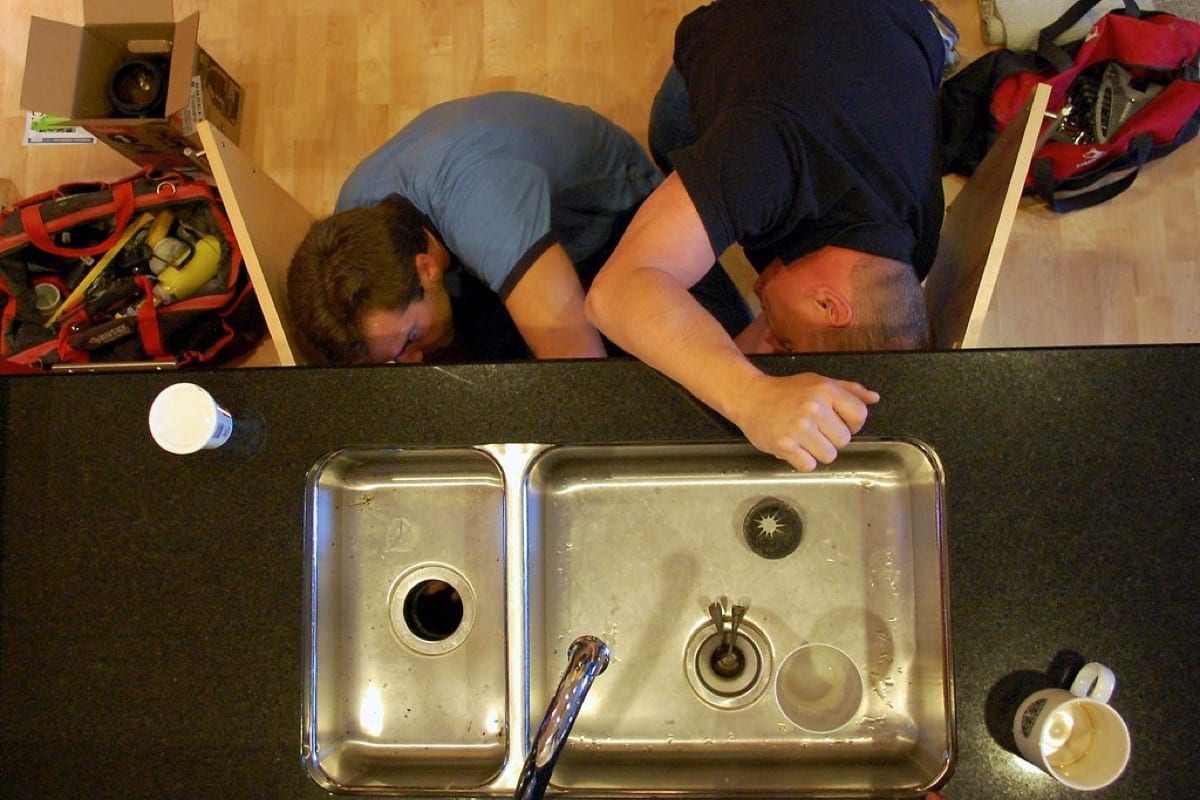 Everything on this job happens from under the sink, which is where the hex socket and the reset button both are. Photo by bradleypjohnson via Flickr, CC BY 2.0, resized.
Free the plate with the hex wrench
Kneel under the sink and find the hex socket in the dead center of the disposal’s underside. Push the wrench in and turn it hard, both directions, until the plate breaks loose and rotates a full circle freely. You’ll feel the moment it releases. If the socket is stripped or your unit doesn’t have one, wedge a broom handle against one of the grinding lugs inside the chamber and lever it around instead, which does the same job with less mechanical advantage.
Press the reset button
With power still off, feel along the bottom of the unit for a small red or black button, usually near the center. If the thermal overload tripped, that button will be sticking out. Push it in until it clicks and holds. On a jam, the overload almost always tripped at the same time, so both steps go together: free the plate first, then reset, or the reset will just pop right back out.
Restore power and test with cold water
Plug it back in, run cold water, and flip the switch. You should get a clean, even grinding sound that settles into a steady hum within a second or two. Let the water run ten seconds after you shut it off. If it runs normally now, the jam was the whole story.
Chase the power if it’s still silent
No hum, no click, nothing at all means the motor isn’t getting power. Work backward: is the plug seated in the outlet, is that outlet switched (many are, and the switch is the one on the wall you already flipped), has the breaker tripped, does another device work in the same outlet. A dead outlet under a sink is its own problem worth tracing properly, and a breaker that won’t hold is a different signal entirely. If power reaches the unit and it still does nothing, the motor has failed and it’s replacement time.
Time and Cost
| Fix | Time | Cost |
|---|---|---|
| Free a jam and reset | 10–20 min | $0 |
| Hex wrench, if yours vanished | shopping trip | $8 |
| New disposal unit, mid-range | 1–2 hrs | $90–$200 |
| Plumber to replace a disposal | 1–2 hrs | $150–$400 |
Why This Works
A garbage disposal has no blades. It has a spinning steel plate with two blunt swiveling lugs that fling food against a stationary grinding ring, which is why hard objects don’t get cut, they get wedged. When something blocks that plate, the motor keeps drawing current trying to turn it, heats up fast, and a thermal overload switch cuts power before the windings cook. That protection is the reason a jammed disposal usually costs nothing to fix: the machine shut itself down before it destroyed itself. The hex socket underneath connects straight to the motor shaft, so turning it manually rocks the plate free from the other side of the jam.
Mistakes to Avoid
- Holding the switch on while it hums. Every extra second of a stalled motor is heat in the windings. One flip to identify the sound, then off.
- Pressing reset over and over without clearing the jam. The overload will keep tripping because nothing changed, and you’ll conclude the unit is dead when it’s fine.
- Reaching in with the wall switch off. The wall switch is not power isolation. Unplug it or pull the breaker.
- Assuming a silent unit is a broken unit. A tripped reset button and an unplugged cord account for a huge share of disposals hauled to the curb every year.
Once it’s spinning again, a jam usually leaves a smell behind from whatever sat in the chamber. That’s a ten-minute job on its own, covered in cleaning a smelly garbage disposal.
A disposal that’s wet along its body seam rather than at a hose or fitting has a failed internal seal, which is one of the four outcomes of the leak-under-the-sink test.
FAQ
Where is the reset button on a garbage disposal?
It's a small red or black button in the center of the bottom of the unit, facing the cabinet floor. You reach it by kneeling under the sink and feeling around the underside of the disposal. Press it firmly until it clicks and stays in. If it pops back out within a minute, the motor is overheating for a reason you have not fixed yet.
Why does my garbage disposal hum but not spin?
The motor is getting power but something is wedged against the spinning plate, so it cannot turn. Usually it's a bone fragment, a fruit pit, a bottle cap, or a spoon. Turn the power off, free the plate with a quarter-inch hex wrench in the socket underneath, then press the reset button.
Can I put my hand in a garbage disposal to clear a jam?
Never, even with the switch off and the power cut. Use tongs or needle-nose pliers to pull objects out, and use a hex wrench underneath to free the plate. The cutting edges are dull but the plate can release suddenly under spring tension, and a jam that clears while your fingers are inside is exactly how people end up in the ER.
How long should a garbage disposal last?
Eight to fifteen years for a decent unit, less for a cheap builder-grade one in a heavy-use kitchen. If yours hums with nothing jammed, trips the reset repeatedly, leaks from the body, or the plate is loose and wobbly, the motor or bearings are done and replacement makes more sense than repair.
Related fixes
Kitchen
Garbage Disposal Smells? Clean It in 10 Minutes (3 Steps)
A stinky disposal is rotting film on the splash guard and chamber walls, not a broken unit. Scrub, flush, and deodorize it with $2 of pantry staples.
Time10–15 min Cost$0–$5 easy
Electrical
How to Reset a Tripped Breaker the Right Way
A tripped breaker often looks like it's still on. Push it fully to off first, then back on, and learn the difference between a nuisance trip and overload.
Time5–10 min Cost$0–$15 easy
.JPG)
Kitchen
How to Unclog a Kitchen Sink Drain Without Calling a Plumber
A kitchen sink that won't drain is almost always grease packed in the P-trap. Plunge it right, pull the trap, and snake the line in under an hour for $15.
Time20–60 min Cost$0–$40 easy